
What is Agave Syrup? A Complete Guide for Indian Consumers (2026)
Agave syrup is a natural plant-based sweetener made from the sap of the Blue Weber Agave plant, a succulent native to Mexico. It's about 1.4 times sweeter than sugar, has a glycemic index of around 17 (compared to sugar's 65), and dissolves instantly in cold liquids. In India, it's used in coffee, cocktails, baking, and as a daily sugar substitute.
That's the short answer. If you've been seeing agave syrup pop up in cocktail recipes, on the shelves of premium grocery stores, or in your favourite YouTuber's pantry, this guide will tell you everything else you need to know before you buy a bottle.
Where does agave syrup actually come from?
Agave syrup comes from a plant that looks like a cross between an aloe vera and a giant artichoke. The Blue Weber Agave (yes, the same plant that gives us tequila) grows in the arid highlands of Mexico, mostly in the state of Jalisco. The plant takes about seven to ten years to mature, which already tells you something about why this isn't a mass-produced ingredient.
Here's how it's made:
- The leaves are cut off the mature plant, leaving the core, which is called the piña because it looks like a giant pineapple
- The piña is crushed or pressed to release its sap, which is naturally sweet and called aguamiel ("honey water" in Spanish)
- The sap is gently heated at low temperatures to break down complex carbohydrates into simple sugars, mainly fructose
- The liquid is filtered and reduced into a syrup with a consistency similar to honey
That's it. No additives, no refining process like white sugar, no bee involvement. The end result is a clear-to-amber liquid that pours like maple syrup and tastes mildly sweet without any sharp or floral notes.
What does agave syrup taste like?
This is the question we get most often, and the answer surprises people. Agave doesn't taste like much. It's clean, mild, and almost neutral, with a very faint caramel hint in darker varieties.
That neutrality is actually agave's superpower. Honey has floral notes that can clash with masala chai. Jaggery has a strong molasses flavour that overpowers a margarita. Stevia has a bitter aftertaste that ruins coffee. Agave just sweetens, gets out of the way, and lets the other flavours shine.
There are two main types you'll find:
Light agave has been minimally processed. It's pale gold, almost neutral in flavour, and is the go-to for cocktails, coffee, smoothies, and delicate baking.
Dark agave has been processed at slightly higher temperatures and has a richer, more caramel-like taste. It works well in marinades, robust baked goods like banana bread, and Indian sweets where you want some depth.
At Fructo, we currently sell light agave because it's the most versatile, especially for Indian kitchens where you'll be using it across very different applications in a single day.
Why is agave syrup suddenly everywhere in India?
Three things happened at once.
First, the cocktail culture in India exploded. The India Bartender Show now has an entire "Agave Village" dedicated to tequila, mezcal, and agave-based mixers. Mumbai and Bangalore both have bars that exclusively serve agave-spirit cocktails. And once people taste a real margarita made with agave syrup instead of sugar syrup, they want to recreate it at home.
Second, the diabetes numbers in India became impossible to ignore. We now have 101 million diabetics and another 136 million prediabetics, which is the largest such population in the world. People are actively looking for lower-glycemic alternatives to sugar, and agave is one of the few options that doesn't taste like a compromise.
Third, the clean-label movement caught on. Walk into any urban supermarket and you'll see brands like The Whole Truth, Yoga Bar, and Two Brothers Organic Farms doing well precisely because they sell single-ingredient, minimally processed food. Agave fits perfectly into that worldview. One ingredient. One sentence on the label.
How does agave syrup compare to sugar?
Here's the honest comparison, with no marketing spin:
| Metric | Agave Syrup | White Sugar |
|---|---|---|
| Glycemic Index | ~17 | 65 |
| Sweetness | 1.4x sweeter | 1x (baseline) |
| Calories per tablespoon | ~60 kcal | ~48 kcal |
| Dissolves in cold | Yes | No |
| Processing | Minimal | Heavy refining |
| Vegan | Yes | Yes |
The big advantage is the glycemic index. Sugar spikes blood sugar fast because it's roughly half glucose, which the body absorbs quickly. Agave is mostly fructose (more on that below), which is processed by the liver and doesn't cause the same blood sugar response. For people watching their energy crashes, this matters.
The catch nobody likes to talk about: agave is high in fructose, around 70 to 90 percent depending on the producer. Fructose is metabolised primarily by the liver, and excessive consumption has been linked to fatty liver concerns in some studies. The takeaway isn't "avoid agave," it's "use it as a sweetener, not as a free pass to consume unlimited amounts." The same logic applies to honey, which is also high in fructose.
How does agave syrup compare to honey?
Honey is the most natural comparison point for Indian consumers because it's the sweetener most of us grew up with as a "healthier alternative."
Agave is plant-based, which makes it suitable for vegans. Honey isn't, and the vegan community in India (now estimated at 2 to 4 million online buyers) has driven a lot of the early demand for agave.
Agave has a lower glycemic index (around 17) than honey (around 58). For diabetics or anyone managing blood sugar, this is a meaningful difference.
Agave dissolves instantly in cold water, iced coffee, and cocktails. Honey doesn't, which is why bartenders mix it with hot water first to make "honey syrup." Agave skips that step entirely.
Honey has flavour. Agave doesn't. Whether that's good or bad depends on what you're making. For warm masala chai where you want a floral note, honey wins. For an iced cold brew where you want clean sweetness, agave wins.
How does agave syrup compare to stevia?
Stevia is technically zero-calorie and zero-glycemic, which sounds like it should win. In practice, most people find stevia has a slightly bitter, almost metallic aftertaste, especially at higher concentrations. It also doesn't have the syrup-like body that you need for cocktails or baking. You can't drizzle stevia over pancakes.
If your only goal is calorie reduction, stevia is excellent. If you want a sweetener that behaves like a sweetener in every recipe, agave is more versatile.
How do you use agave syrup in Indian kitchens?
The short answer: almost anywhere you'd use sugar. Here are the most common uses we see from Fructo customers.
In coffee and tea. One teaspoon in your morning coffee dissolves instantly. For masala chai, add it after the chai is poured, not while boiling. Agave doesn't need heat to dissolve.
In cocktails and mocktails. This is what made agave famous globally. A classic Tommy's Margarita is just tequila, lime juice, and agave. No triple sec, no sugar syrup. The same template works for palomas (tequila, grapefruit, agave, soda), daiquiris, and pretty much any sour cocktail. For mocktails, lime juice plus agave plus soda is the cleanest summer drink you'll ever make.
In baking. Use about three-quarters of the agave for every cup of sugar a recipe calls for, since agave is sweeter. Also reduce other liquids by about a quarter cup, since agave is itself a liquid. It works beautifully in banana bread, muffins, granola bars, and modern takes on Indian sweets like rasgulla syrup.
In dressings and marinades. A teaspoon of agave balances the acidity in any vinaigrette or chutney. It also helps glazes caramelise without burning, which is useful for grilled paneer or tikkas.
In everyday cooking. Smoothies, overnight oats, yogurt bowls, dal makhani (yes, really, a tiny bit of sweetness rounds out the richness), and any recipe that calls for a pinch of sugar.
Is agave syrup safe for diabetics?
This is the question we get most often, and we want to be careful here.
Agave has a glycemic index of approximately 17, which is much lower than sugar (65) or honey (58). In a study by Wolever and colleagues published in 2010, agave produced significantly smaller blood glucose spikes in type 2 diabetics compared to sucrose.
However, agave is high in fructose, and the long-term health implications of high-fructose diets, particularly for liver health, are still being studied. The current best practice is to use agave as a lower-GI alternative to sugar, in moderation, and ideally in consultation with your doctor or nutritionist if you have diabetes or any liver condition.
We are not making medical claims here. Agave is a sweetener, not a treatment. If you're managing diabetes, please talk to your healthcare provider before making dietary changes.
Is agave syrup keto-friendly?
No. One tablespoon of agave contains around 16 grams of carbohydrates, and a strict keto diet typically caps daily carbs at 20 to 50 grams. Agave will use up your entire daily carb allowance in a single tablespoon. For keto, stevia or monk fruit are better choices.
We're being honest about this because we'd rather lose a sale than have a customer feel misled. If you're on keto, agave is not for you.
Is agave syrup vegan?
Yes, 100 percent. Agave is a plant. It doesn't involve any animals at any stage of production. This is one of agave's clearest wins over honey for the vegan community.
How long does agave syrup last?
An unopened bottle of agave syrup will last two to three years stored at room temperature. Once opened, it lasts about 12 months. Unlike honey, it doesn't crystallise or harden over time, so you don't need to refrigerate it. Just keep it in a cool, dark cupboard.
A 400ml bottle typically lasts a daily coffee drinker about 30 to 45 days. For occasional cocktail or baking use, the same bottle can last two to three months.
Where can you buy agave syrup in India?
For most of the last decade, the only way to get agave syrup in India was to order imported bottles from Amazon, often paying 800 to 1,200 rupees for inconsistent quality.
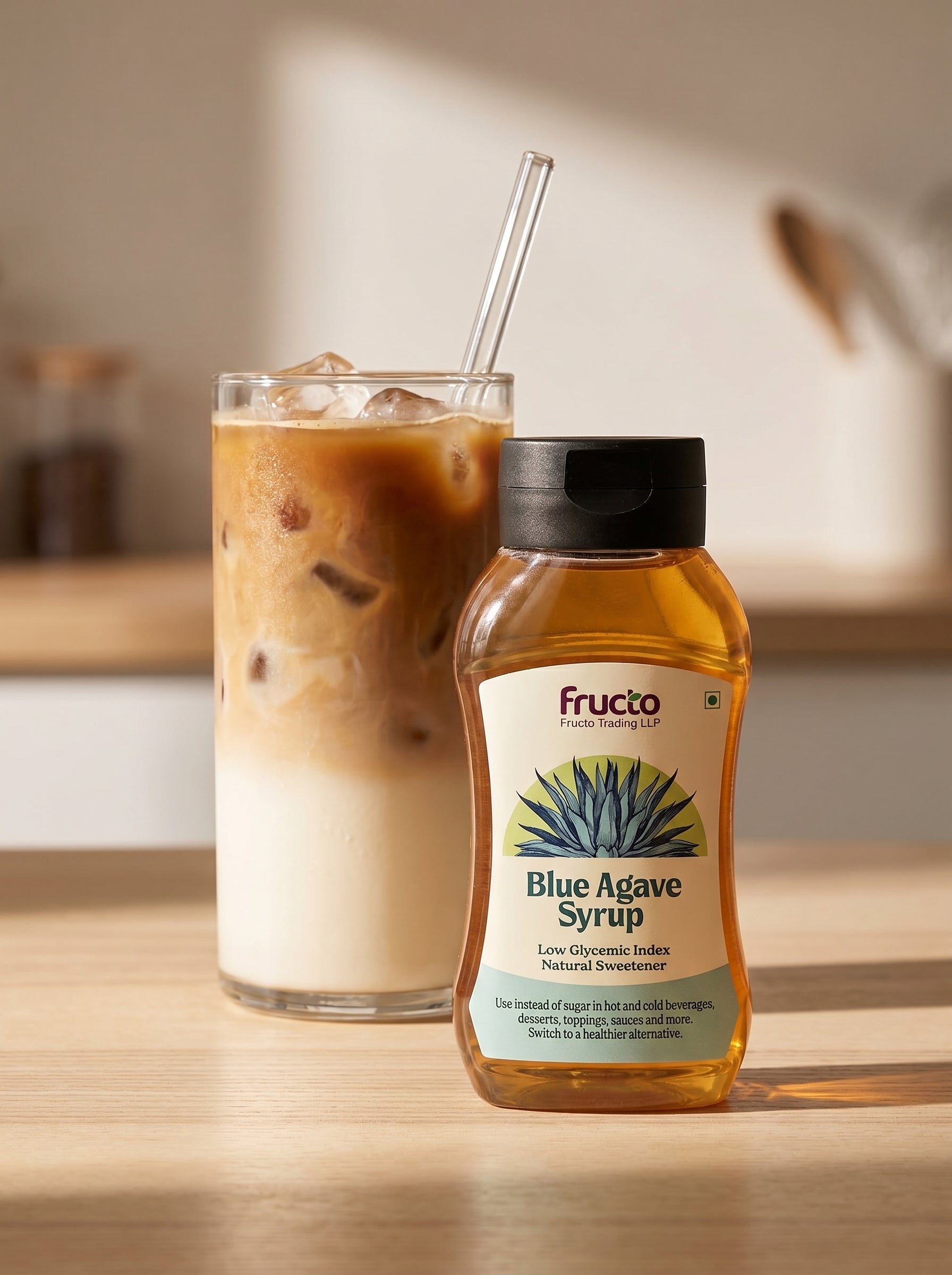
Today, you can buy Fructo Blue Agave Syrup in India directly through our online store at fructo.in, and on Amazon India. The 400ml bottle is priced at ₹529.
Frequently Asked Questions
Is agave syrup the same as agave nectar? Yes. The terms are used interchangeably. "Nectar" is more common in older recipes and on imported bottles. "Syrup" is more common in modern usage.
Can I use agave instead of honey in tea? Yes, and you don't need to wait for the tea to cool down. Agave dissolves at any temperature.
Does agave have a strong smell? No. It's almost odourless, with a faint sweet note when you open the bottle. This is one reason it works so well in cocktails where strong aromas would interfere.
Is agave gluten-free? Yes. Agave is naturally gluten-free, which makes it safe for people with celiac disease or gluten sensitivity.
Can children eat agave syrup? For children over one year old, agave is generally safe in moderation. For infants under one year, no sweetener (including honey and agave) is recommended due to general infant nutrition guidelines.
Why is agave syrup more expensive than sugar? Three reasons. The agave plant takes seven to ten years to mature. It's imported from Mexico. And it's produced in much smaller quantities than industrially refined sugar. At ₹529 for a 400ml bottle, Fructo agave works out to roughly ₹1.32 per ml, which is competitive with premium honey.
The bottom line
Agave syrup isn't a miracle ingredient and we're not going to pretend it is. It's a natural, plant-based sweetener with a lower glycemic index than sugar and honey, a clean neutral taste, and the unique ability to dissolve in cold liquids. For most people switching from refined sugar, it's a meaningful upgrade. For diabetics, it's worth a conversation with your doctor. For home bartenders, it's non-negotiable.
If you want to try Fructo Blue Agave Syrup for yourself, our 400ml bottle at ₹529 is the best way to start. Most customers tell us they're hooked within a week.
Try Fructo Blue Agave Syrup | Read: Agave Syrup vs Sugar - Which Is Healthier?
0 comments